
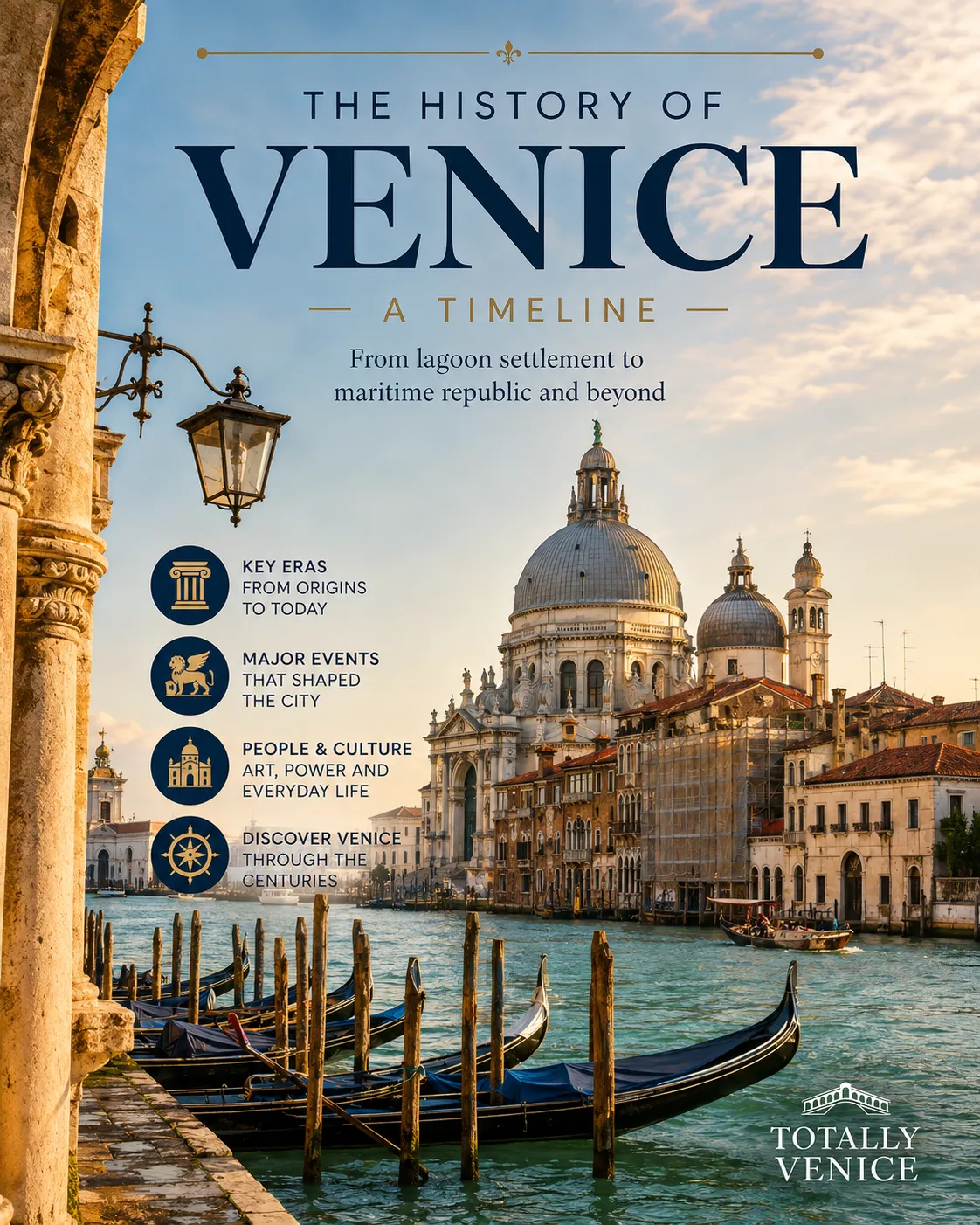
Venice's history is unusually legible for a city this old, because so much of it survives in the fabric of the place itself — you can still trace the shape of the Republic in its buildings, streets and rituals.

5th–8th centuries: refuge in the lagoon

Mainland populations fled into the marshy Venetian lagoon during the collapse of Roman authority and successive invasions, settling on scattered islands that offered natural defence. Tradition dates the city's founding to 421 CE, though the settlement grew gradually rather than at a single moment.

9th–13th centuries: the rise of a maritime republic

Venice developed into an independent maritime republic, the Serenissima, governed by an elected Doge and a complex system of councils designed specifically to prevent any single family from seizing permanent power. Trade with the Byzantine and Islamic worlds made the city extraordinarily wealthy, and St Mark's relics — brought from Alexandria in 828 — gave it religious as well as commercial prestige.

13th–15th centuries: peak empire

At its height, Venice controlled trade routes and territories across the Adriatic and eastern Mediterranean, from Cyprus to Crete to outposts along the Dalmatian coast. The Arsenale, its state shipyard, could reportedly build a warship in a single day at peak efficiency — an industrial achievement centuries ahead of its time.

15th–18th centuries: slow decline, artistic peak

New sea routes to Asia around Africa gradually undercut Venice's trade monopoly, even as the city produced its greatest art — Titian, Tintoretto, Veronese — and its most extravagant Carnevale culture.

1797: the fall

Napoleon ended the Republic's 1,100-year independence without a fight, and Venice passed between French and Austrian control before joining unified Italy in 1866.

20th century–today

Industrial development on the mainland at Marghera, and later mass tourism, reshaped Venice's economy and population. Fewer than 50,000 people now live in the historic centre — down from a peak of well over 100,000 — a shift that shapes much of the current debate around tourism, housing and the city's future.