
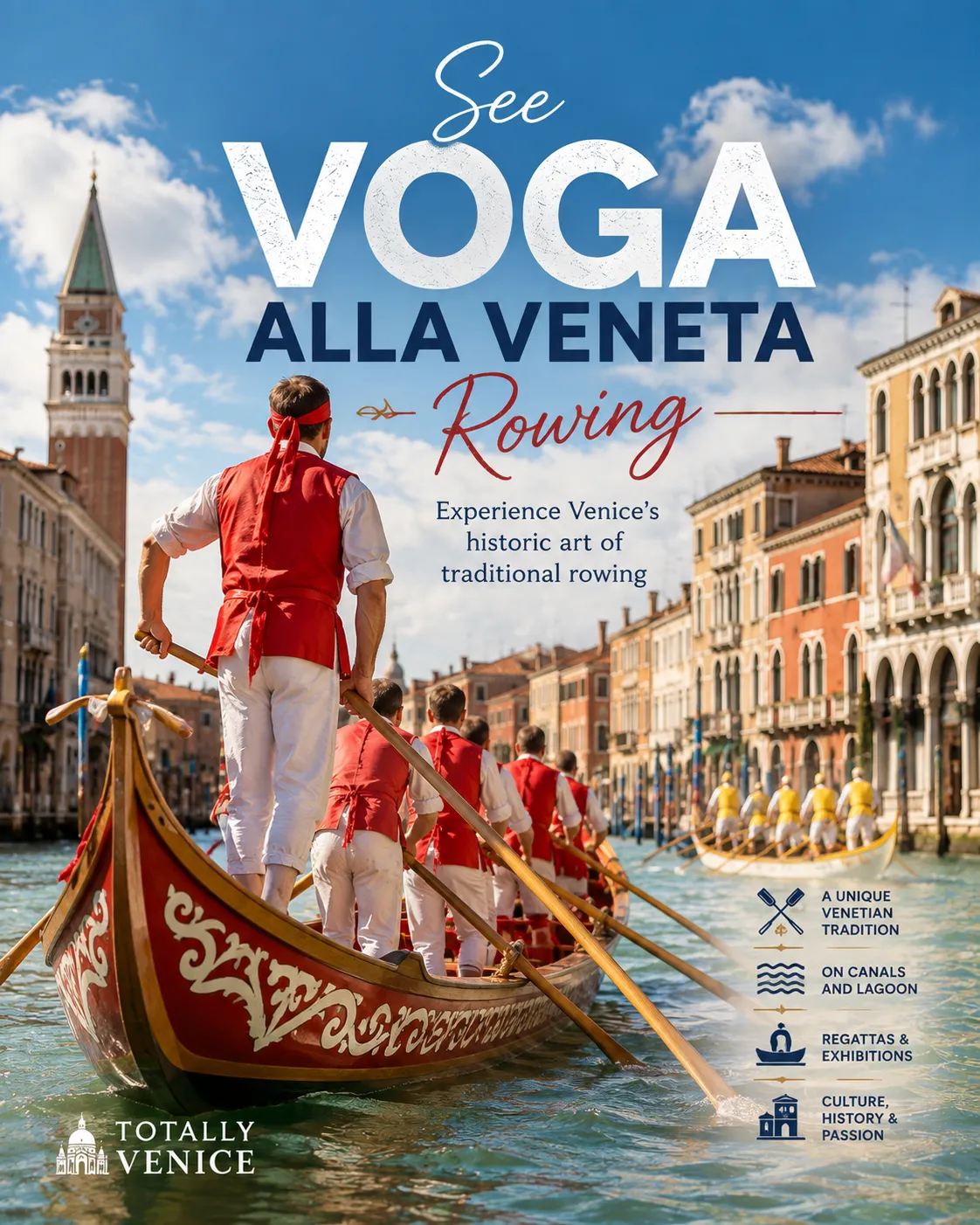
Voga alla veneta — rowing standing up, facing forward, with a single oar worked against a fixed wooden fulcrum — is the technique behind every gondola, and it's specific to Venice's lagoon in a way most visitors never get explained to them.
Why Venice rows differently
Most rowing traditions elsewhere have rowers seated, facing backward, often with two oars. Venice's shallow, crowded, canal-threaded lagoon called for something else: standing gives a rower far better visibility over a boat's bow in tight canals, and the fixed forcola (an intricately carved wooden oarlock, different for every boat and rower) lets a single oar generate forward thrust, steering, and braking all from one continuous stroke — an efficient answer to navigating a city with no straight lines.
Where to actually try it
Several Venice-based rowing clubs and cultural associations offer hands-on voga alla veneta lessons for visitors, typically in a sandolo (a flat-bottomed, more stable boat than a gondola) rather than a gondola itself. Sessions usually run an hour or two, on quieter stretches of canal or open lagoon, and are a genuinely different way to understand the city's geography — you feel the currents and tight turns a walking tour never shows you.
The Vogalonga
If you want to see the technique at full scale, the Vogalonga ("long row") is an enormous, non-competitive rowing event each spring, when thousands of rowers in traditional Venetian boats take over the lagoon for a roughly 30 km course — one of the best free spectacles in the Venetian calendar, and a good time to spot voga alla veneta in every variation, from solo gondolas to boats with a dozen rowers.
Worth it?
If a gondola ride feels too passive, an hour actually learning the stroke — even just enough to keep a boat moving in a straight line — tends to leave a much deeper impression of the city's relationship with its water than watching someone else do it.