
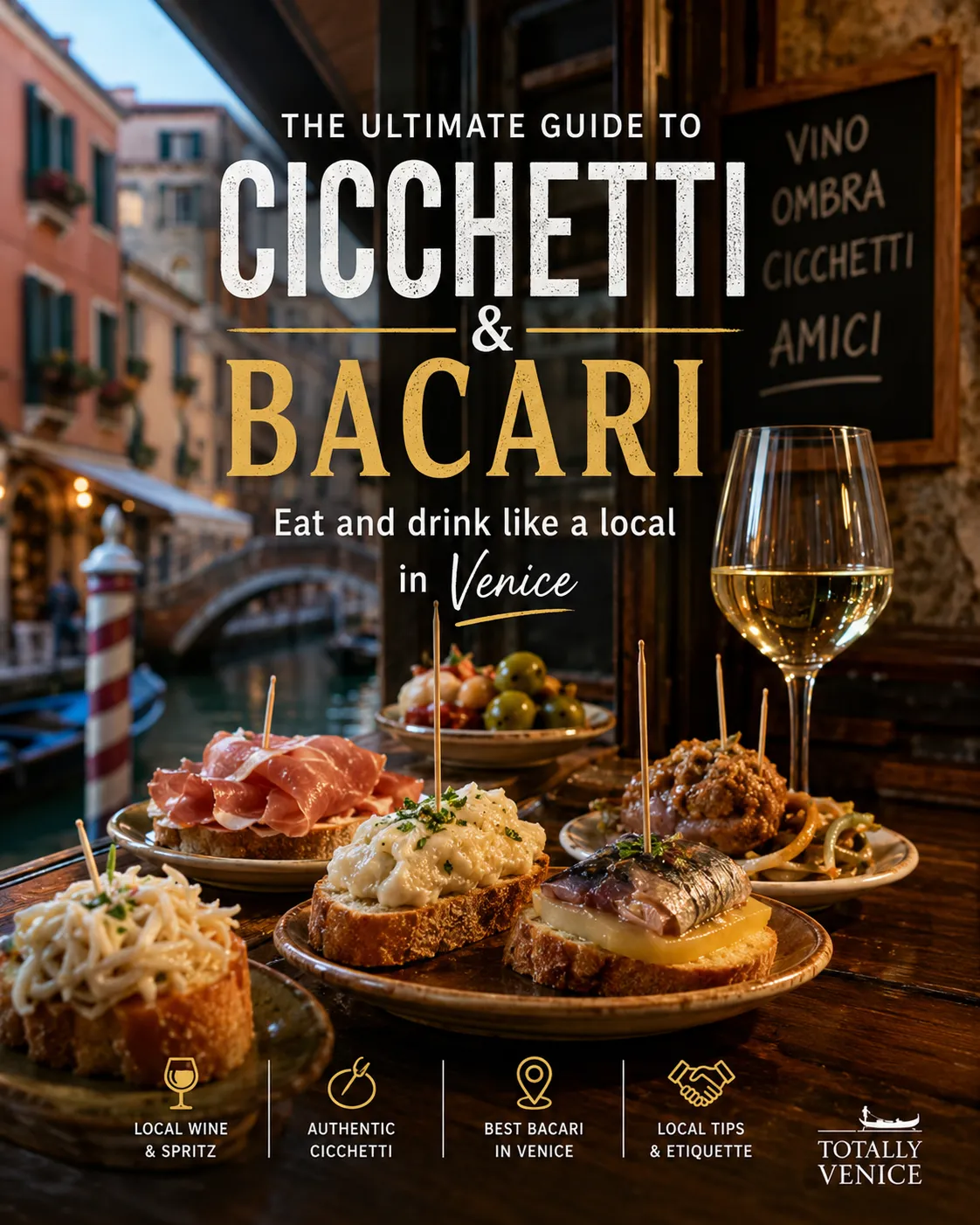
Cicchetti are the easiest way to understand how Venice eats when nobody wants a formal meal. They are small bites served in a bacaro — a traditional Venetian wine bar — and they work best as a moving meal: one or two pieces, a small drink, then another stop a few streets away.
They are often compared with Spanish tapas, which is useful as a starting point, but the Venetian rhythm is its own thing. A good cicchetti crawl is short, social and flexible rather than a giant plate ordered all at once.
First: what counts as cicchetti?
There is no single compulsory format. You may see slices of bread topped with baccalà mantecato (creamed salt cod), anchovies, cured fish, cheese or vegetables; polpette; fried seafood; boiled egg; sarde in saor with onion, vinegar, raisins and pine nuts; or whatever the kitchen has prepared that day.
Some bacari lean heavily on crostini, others on fried food or traditional seafood. The best counter usually looks like food that has been made for that particular bar, not a catalogue of identical toppings designed for photographs.
The word you will also hear is ombra: a small glass of wine. The familiar story links the name to the shade of St Mark's campanile, where wine sellers supposedly moved with the shadow to keep their wine cool. Whether you treat that origin story as literal history or Venetian folklore, ordering “un'ombra” is still a very local way to ask for a small wine.
How a giro d'ombre works
A giro d'ombre is a round of wine bars rather than one long sitting. The useful rule for visitors is simple:
- Pick a bacaro that looks active rather than one with a tout outside.
- Order one or two cicchetti per person and a small wine, spritz or non-alcoholic drink.
- Eat at the counter or wherever the bar directs you.
- Pay attention to whether the bar wants payment when ordering or at the end — practices vary.
- Move on while you are still hungry enough to enjoy the next place.
Two or three stops can make a proper light meal. Four or five becomes an evening. You do not need to turn it into a drinking contest; the food and the movement between neighbourhood bars are the point.
Where to look
Cannaregio
The lanes around the Jewish Ghetto, Fondamenta della Misericordia and Fondamenta dei Ormesini are an easy place to build a crawl. The area has enough bars close together that you can reject somewhere that feels wrong and keep walking. It also becomes noticeably more local once you move away from the direct station–Rialto route.
Rialto and San Polo
The streets around the Rialto Market are one of the historic centres of Venetian food culture. This is a good area for traditional seafood flavours and for combining cicchetti with a morning or lunchtime market visit. Avoid judging the whole district by the busiest bridge approaches; a few turns can completely change the atmosphere.
Dorsoduro
Around Campo Santa Margherita and toward the Zattere you will find a younger, more relaxed evening scene. It works especially well if you are staying in Dorsoduro and want a crawl that ends with a waterfront walk rather than a trek back across the city.
Castello
Move east from San Marco toward Via Garibaldi and the Arsenale and the restaurant mix changes. Castello can be excellent for a slower, less checklist-driven evening, particularly for repeat visitors and Biennale trips.
What to order at least once
You do not need a food bucket list, but a few classic flavours help make sense of the counter:
- Baccalà mantecato: salt cod worked into a creamy spread, often served on bread or polenta.
- Sarde in saor: sardines with sweet-sour onion; historically practical preservation food, now one of Venice's signature flavours.
- Polpette: small meat, fish or vegetable balls; recipes vary enormously by bar.
- Seafood cicchetti: look for seasonal preparations rather than assuming every seafood topping is a year-round local speciality.
- Tramezzini: soft triangular sandwiches are not cicchetti in the narrowest traditional sense, but they are part of the everyday Venetian bar landscape and useful when you want something more substantial.
If the counter has several unfamiliar items, asking “Cosa mi consiglia?” — what do you recommend? — is usually more rewarding than defaulting to the most recognisable topping.
When to go
Late morning into lunch and the early-evening aperitivo period are the natural times. Exact opening hours vary widely and small bars may close one day a week or take an afternoon break, so never build a rigid crawl around five places without checking them on the day.
A useful strategy is to save a cluster of bars in one neighbourhood rather than a single “must visit” address. Venice rewards improvisation, and a famous bacaro with a queue out the door is not automatically better than the busy little bar around the corner.
Standing, sitting and table charges
Traditional bacari are often tiny. Standing at the bar is normal, and some places have almost no seating. If there are proper outdoor tables with table service, do not assume the counter price and seated-service price are identical. Ask before settling in if budget matters.
Do not occupy a four-person table for an hour over one cicchetto when the bar is packed. The rhythm is quick: order, eat, talk, move.
Wine, spritz and non-alcoholic options
An ombra of house wine is the classic partner, but there is no rule that you must drink alcohol. Water and soft drinks are normal orders, and an increasing number of bars have alcohol-free aperitivo options. If you are doing several stops, alternating drinks with water makes the evening much more enjoyable.
For spritz, Venice is strongly associated with Select, alongside Aperol and Campari. A spritz is usually an aperitivo drink, not something that needs to accompany every plate.
How to spot a tourist trap
No single sign proves a place is bad, but caution is sensible when several appear together: a menu built around huge laminated photos, staff aggressively pulling people in from the lane, an empty bar beside busy local competitors, or prices that are hard to find before ordering.
By contrast, a short counter, clear prices, people dropping in for one drink, food being replenished in small batches and staff comfortable explaining what is in front of you are all encouraging signs.
Food safety and allergies
Cicchetti counters often contain fish, shellfish, dairy, egg, gluten and nuts in close proximity. If an allergy is serious, do not rely on recognising the topping by sight. Say clearly what you cannot eat and ask about cross-contact; for severe allergies, a busy standing bar may not be the best environment for a complicated order.
Useful phrases include “Sono allergico/a a…” (I am allergic to…) and “Contiene…?” (Does it contain…?).
A simple first-night crawl
For a first evening, choose one neighbourhood, not the entire city. Start around 18:00–18:30, have one or two cicchetti at the first place, move to a second, then decide whether you want a third stop or a sit-down dinner. That keeps the evening spontaneous and avoids spending half of it marching between saved pins.
The Venice rule
Do not hunt one “best bacaro”. The pleasure is the giro: a couple of bites, a small drink, a short walk, another counter. Pick a neighbourhood with several good-looking options and let the evening unfold.