
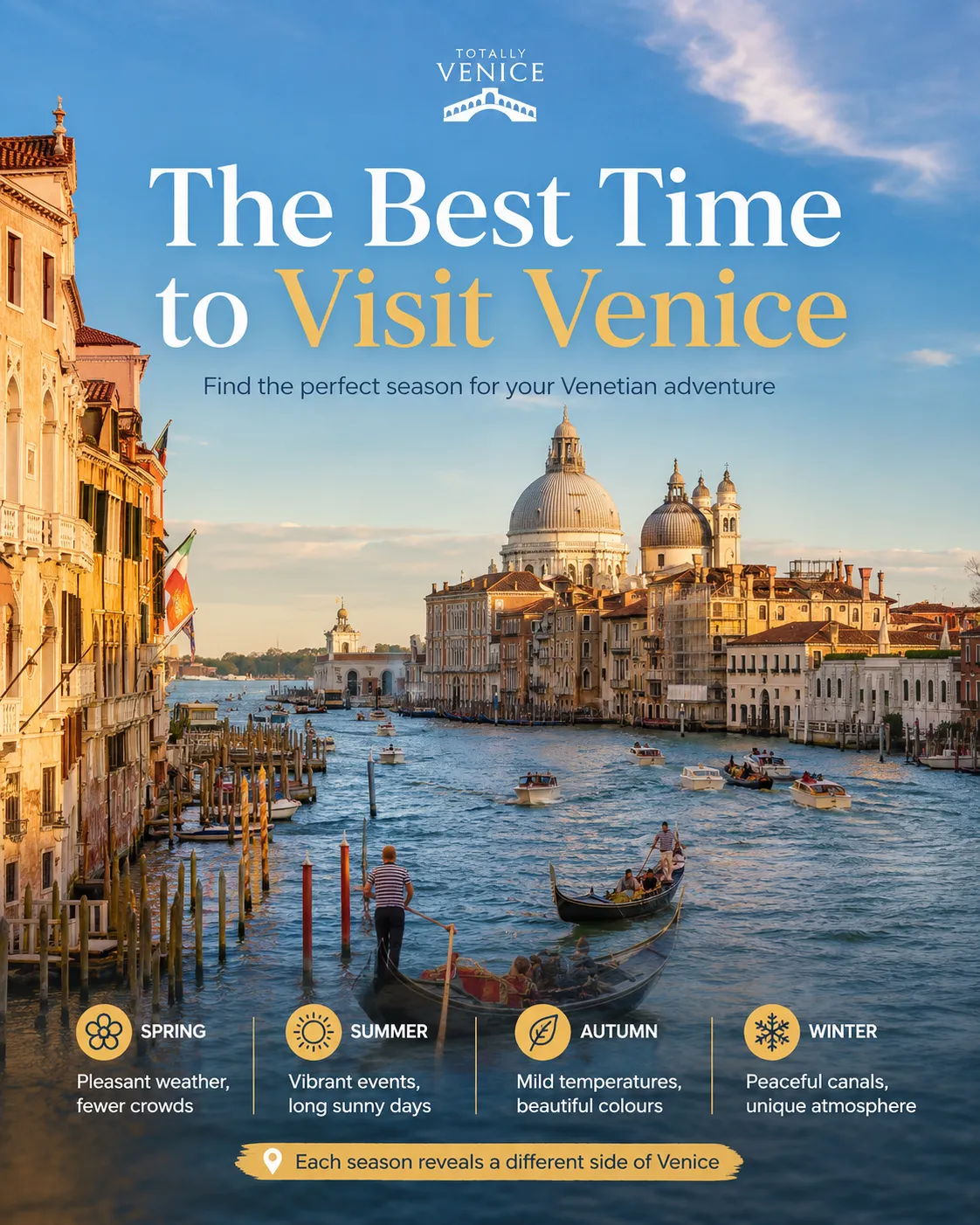
Venice is visitable year-round, but the experience changes sharply with heat, events, daylight, flooding risk and day-trip pressure. The best month is not simply the month with the nicest weather; it is the month whose trade-offs suit the trip you actually want.
Quick answer
For most first-time visitors, late April to early June and mid-September to October offer the best balance of comfortable walking weather, useful daylight and fewer peak-summer stresses. May and October are especially strong if you can travel outside major holiday weekends.
Choose winter if price and atmosphere matter more than daylight and weather certainty. Choose summer if you want long evenings, the Lido and major events, but plan around heat and crowds rather than pretending they are minor inconveniences.
A 2026 planning note: the Access Fee trial has finished
Venice's 2026 Access Fee trial ran on 60 selected days from 3 April to 26 July, generally between 08:30 and 16:00. The official Venezia Unica information now states that the 2026 trial has ended and, from 27 July 2026, visitors can enter Venice without paying the fee or requesting an exemption.
That matters if you are travelling now: do not rely on an old spring or early-summer article telling you to buy a 2026 QR code. For a future year, check the official Comune di Venezia or Venezia Unica Access Fee pages before assuming the 2026 arrangement has continued unchanged.
Spring: excellent, but not one single season
March can still feel wintry, especially in wind or rain, but it is often calmer than April and May. It suits travellers who value museums, churches and long lunches more than warm evenings.
April brings longer days and increasingly comfortable walking weather. Easter and holiday weekends can be busy, so compare your exact dates rather than treating the whole month as shoulder season.
May is one of the easiest months for a first trip. Temperatures are generally more forgiving than midsummer, evenings are usable, and the city feels lively without requiring a heat-management strategy every afternoon. In 2026, the Biennale Arte runs from 9 May to 22 November, so Giardini, Arsenale and associated venues add another reason to visit — and another source of local demand.
Summer: workable if you plan the day differently
June gives you long daylight and a full event calendar, but the city becomes steadily busier and hotter. Start important outdoor sightseeing early, use the middle of the day for a long meal or indoor visit, then return outside in the evening.
July and August are the hardest months for travellers who dislike humidity, packed routes around San Marco and Rialto, or long exposed waits at vaporetto stops. They are not 'bad' months — they simply reward a different itinerary. The Lido, slower neighbourhood evenings and pre-booked major sights make more sense than trying to sprint through a checklist from 10:00 to 16:00.
Carry water, use shade whenever you can and take heat seriously. Venice involves more walking, bridges and standing than the map suggests.
September: strong, with major-event pressure
September is one of Venice's most attractive months, but check the calendar. The 83rd Venice International Film Festival runs 2–12 September 2026 on the Lido. That does not make the historic centre unusable, but it can affect accommodation demand and transport around the Lido.
Later in September usually offers a very appealing combination of warm conditions and slightly less peak-summer intensity.
October: one of the best all-round choices
October is a strong choice for people who want to walk for hours without midsummer heat. The light softens, evenings become cooler and the city can feel more manageable outside major event weekends.
The trade-off is weather variability. Pack a light waterproof layer and do not build a trip that collapses if one afternoon turns wet.
November to February: quieter Venice, different risks
Late autumn and winter can be wonderfully atmospheric. Hotel demand is often softer outside Christmas/New Year and Carnevale, museums are easier to enjoy slowly, and early mornings can feel almost private.
The disadvantages are shorter daylight, colder damp conditions and greater exposure to acqua alta periods. MOSE has greatly reduced the most disruptive high-water events, but it has not made tide awareness irrelevant. Check the City of Venice tide forecast when conditions look unsettled, especially if mobility is limited.
Carnevale temporarily changes the winter equation. If costumes, masks and events are the point, book around it deliberately. If they are not, avoid the busiest Carnival dates rather than paying festival-period prices by accident.
When Biennale Arte changes the decision
The 2026 Biennale Arte runs 9 May to 22 November at Giardini, Arsenale and other venues. If contemporary art is a major reason for your trip, that window may outweigh pure weather considerations. The Biennale itself notes that weekends tend to be busier and weekdays calmer.
Film, theatre, dance and music festivals also create shorter demand spikes. Always check your exact dates before assuming a 'quiet' month will be quiet.
Acqua alta: plan for forecasts, not folklore
High water is most associated with autumn and winter. MOSE barriers now protect the lagoon during the highest forecast events, so old photos of widespread flooding are not a reliable picture of an average modern visit.
Still, lower-lying areas such as Piazza San Marco can be affected before higher parts of the city. If a significant tide is forecast, follow official municipal information and allow extra time. Do not buy disposable overshoes weeks in advance because a generic blog says November equals flooding every day.
Best month by traveller type
- First trip: May, late September or October.
- Lower-budget city break: January or early December, avoiding holiday peaks.
- Art-focused trip: May to November during Biennale Arte 2026.
- Beach plus Venice: June to early September, accepting hotter city sightseeing.
- Photography and atmosphere: winter, March or late autumn.
- Heat-sensitive traveller: April, May, October or early November.
- Carnevale fan: travel for the event and book far ahead.
Booking strategy matters as much as month
A 'good' month with an expensive Saturday can cost more than a 'busy' month with a sensible midweek stay. Compare accommodation before buying flights, check major event dates, and reserve timed attractions that matter to you.
If you have flexibility, arriving Sunday to Thursday often gives you a better chance of enjoying Venice after day trippers thin out in the evening.
Bottom line
There is no secret empty month. For most people, May and October are the safest recommendations, with late September close behind. Winter is excellent for atmosphere and value if you accept shorter days and tide/weather uncertainty. Summer can still be rewarding, but only if you build the day around heat, crowds and slower pacing rather than fighting them.
Before travelling, check the current official Access Fee status, tide forecast and event calendar for your exact dates.