
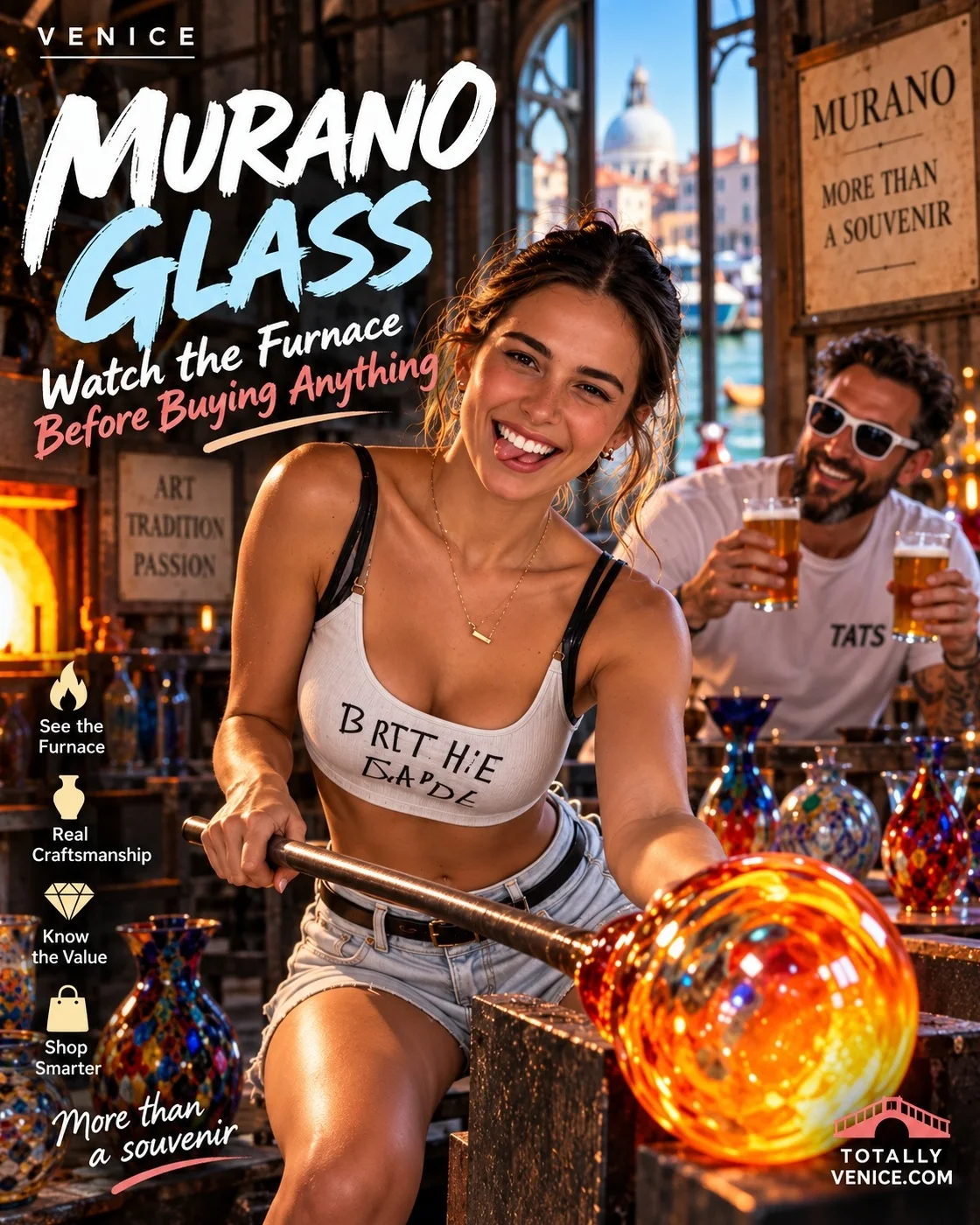
Murano's status as the centre of Venetian glassmaking wasn't really a choice — it was a 1291 city ordinance, moving all of Venice's glass furnaces to the island to reduce fire risk in the tightly packed wooden city. The unintended side effect was that Murano's glassmakers, isolated together on their own island, developed techniques in close-guarded secrecy that made Venetian glass the finest in Europe for centuries.
The techniques that define Murano glass
- Millefiori ("thousand flowers") — canes of colored glass sliced to reveal flower-like cross-sections, fused into beads and decorative pieces.
- Filigrana — fine threads of white or colored glass twisted into spiralling patterns within clear glass.
- Aventurine — glass flecked with copper crystals, giving a glittering, sparkling effect, developed on the island in the 17th century.
- Cristallo — an exceptionally clear, colorless glass developed by Murano masters in the 15th century, a genuine technical breakthrough that competitors across Europe spent decades trying to replicate.
Visiting Murano
A short vaporetto ride from Fondamente Nove, Murano is easily done as a half-day trip. Several furnaces (fornaci) offer live glassblowing demonstrations, and the Museo del Vetro (Glass Museum) traces the island's techniques and history in real depth if you want more than a demonstration.
Buying genuine Murano glass
Authentic Murano glass typically carries a "Vetro Artistico Murano" trademark or a maker's signature, and is priced accordingly — a general rule of thumb is that suspiciously cheap "Murano glass" sold in mainland Venice souvenir shops is very often mass-produced elsewhere. If authenticity matters to you, buying directly from a Murano workshop is the safest route.