
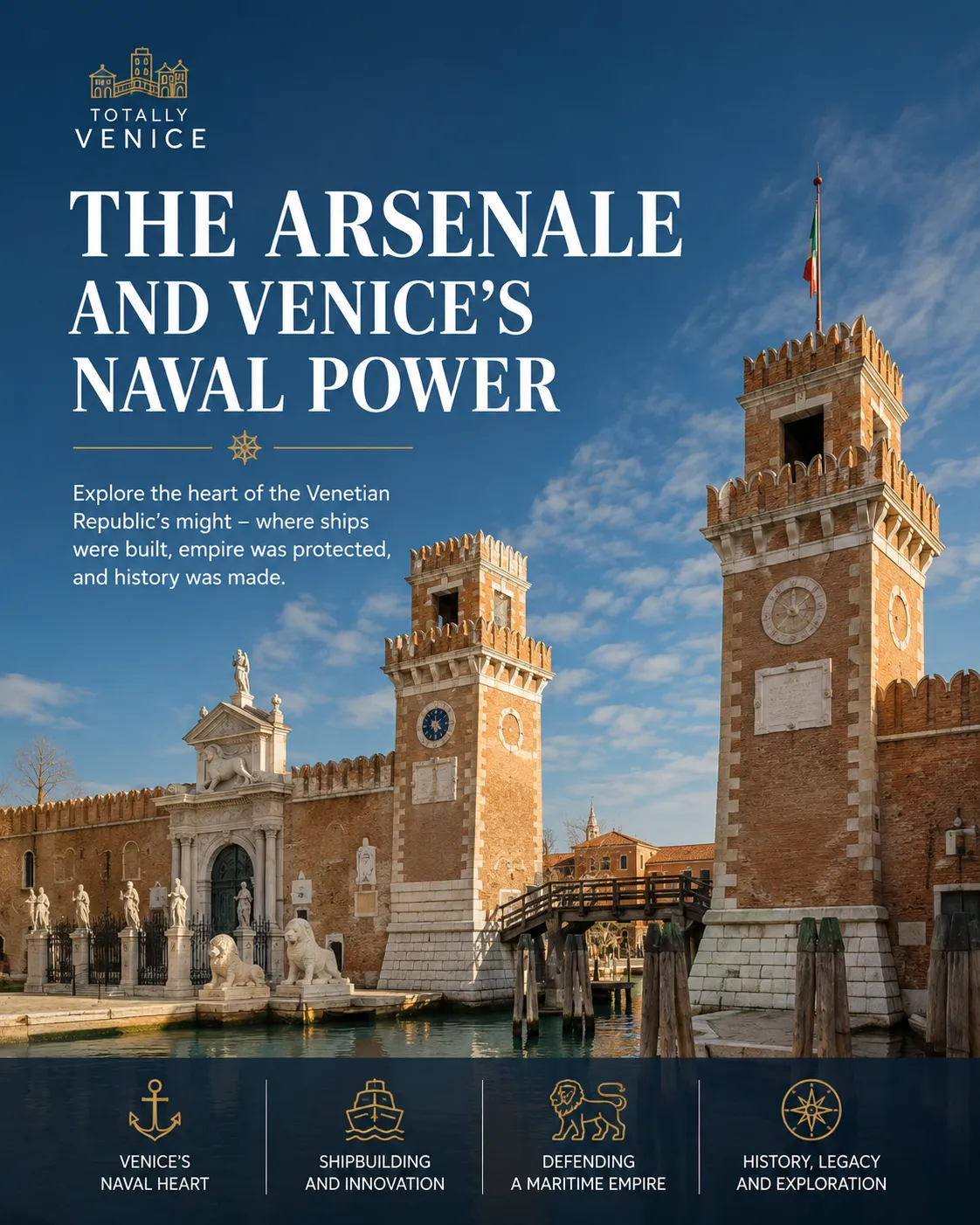
For centuries, the Arsenale was arguably the most advanced industrial facility in the world — a state-owned, purpose-built shipyard complex in Castello that let Venice out-build every rival navy and merchant fleet in the Mediterranean.
An early production line
Founded in the early 12th century and expanded repeatedly over the following centuries, the Arsenale organised shipbuilding into something close to a modern assembly line, centuries before the concept had a name: standardised parts, specialised workshops for rope, sails, weapons and hulls arranged around a sequence of basins, and a workforce — the arsenalotti — numbering in the thousands at its peak. Contemporary accounts describe the Arsenale capable of completing a fully outfitted galley in a single day under wartime pressure, an almost unbelievable rate for the era, achieved through pre-built standardised components rather than building each ship from scratch.
Why it mattered
Venice's entire strategic position — its trade routes, its colonies across the eastern Mediterranean, its ability to project naval power against Ottoman and rival Italian fleets — rested on the Arsenale's capacity to build and repair ships faster than anyone else. It wasn't just infrastructure; it was the Republic's core strategic asset, guarded accordingly, with the arsenalotti forming a trusted class who also served as the Doge's personal guard on ceremonial occasions.
What survives, and what you can see
Much of the Arsenale complex remains an active naval facility today, closed to the general public for most of the year. The monumental land gate (Porta di Terra), guarded by stone lions taken as war trophies from Greece, is visible from outside year-round. Part of the grounds and historic buildings open to visitors during the Venice Biennale, offering a rare walk through part of the complex — see our Biennale guide for details.
The legacy
The English word "arsenal," now generic for any weapons store, derives directly from this one Venetian institution — a small linguistic reminder of how thoroughly the Venetian Arsenale shaped European ideas about industrial-scale military production for centuries after.