
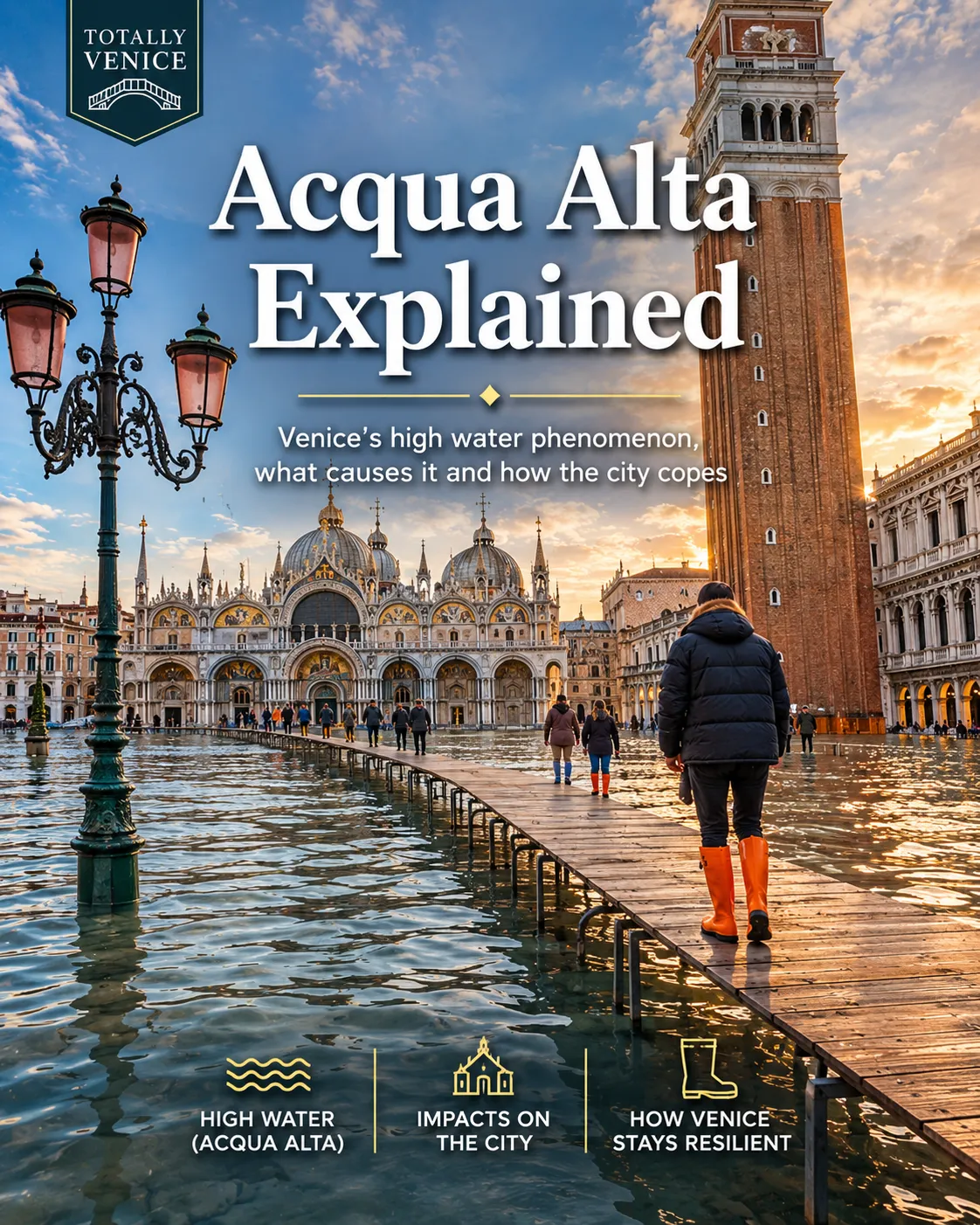
Acqua alta — literally "high water" — is the exceptional tide phenomenon that periodically floods Venice's lowest-lying areas, and it's one of the most misunderstood things about the city among first-time visitors, often imagined as a constant, city-wide problem rather than the occasional, localised, largely-managed event it actually is today.
What causes it
Acqua alta happens when several factors combine: an unusually high astronomical tide, sustained scirocco winds pushing water up the Adriatic and into the lagoon, and sometimes low atmospheric pressure adding further lift — when enough of these stack together, sea level in the lagoon rises high enough to flood the lowest parts of the city, Piazza San Marco and parts of San Marco sestiere first, since they sit at the lowest elevation in the historic centre.
How often it actually happens
Minor flooding events (a matter of centimetres, mainly affecting St Mark's Square) occur on a modest number of days each autumn and winter — an ordinary, planned-for seasonal feature of living in a lagoon city, not a crisis. Genuinely severe flooding, affecting large parts of the city at depth, is now rare.
The MOSE system
Since becoming operational in 2020, the MOSE mobile barrier system — rows of gates at the lagoon's three inlets that rise to seal off the sea during forecast exceptionally high tides — has prevented a repeat of events like the catastrophic November 2019 flood, which put roughly 80% of the city underwater. See our MOSE explainer for how the system actually works.
What it means if you're visiting
For most visitors, even during peak acqua alta season, the practical reality is: check tide forecasts if you're there between autumn and spring, expect the possibility of a few ankle-deep hours around St Mark's Square on the odd day, and pack accordingly — see our packing guide for specifics. Raised wooden walkways (passerelle) go up automatically in flood-prone areas when needed, letting the city largely function as normal even on a wet day.