
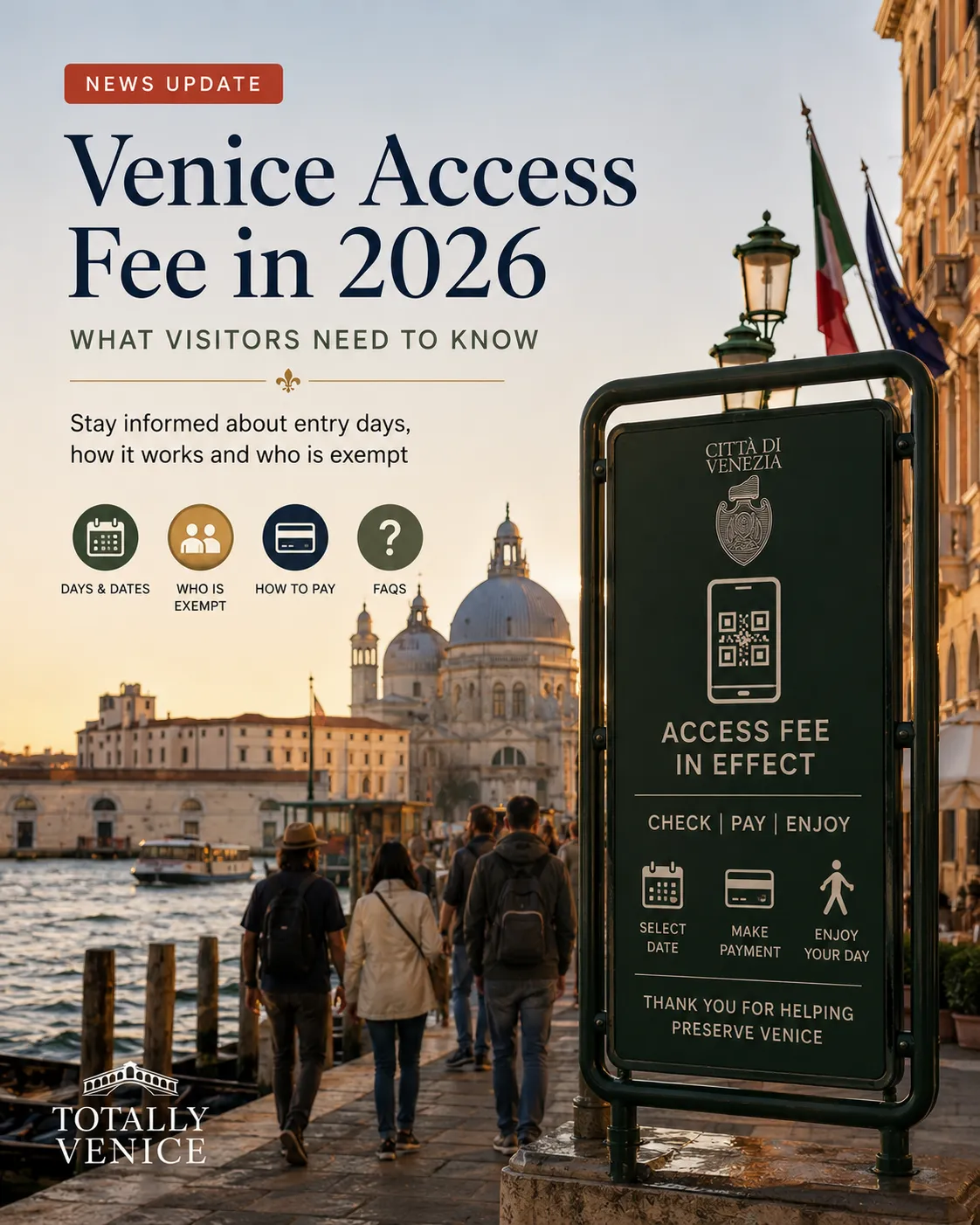
Venice's day-tripper entry fee — officially the Contributo di Accesso (Access Fee, sometimes called "CDA") — is one of the most-searched and most-misunderstood pieces of practical information for anyone planning a trip. This guide covers exactly how it worked for the 2026 trial season, who actually had to pay, how the booking system works, and what the rules mean for a trip you're planning now. Every figure and rule below is drawn directly from the City of Venice's own official portal, cda.ve.it, and its detailed FAQ page — linked throughout so you can verify anything yourself and check for updates.
The short version
The Access Fee applied on 60 specific days between 3 April and 26 July 2026, from 8:30 a.m. to 4:00 p.m., to anyone entering Venice's historic centre (Centro Storico) without an overnight booking in the municipality. It cost €5 if booked at least four days ahead, or €10 if booked closer to the date or paid on arrival. As of 27 July 2026, the 2026 trial period has ended — the fee currently does not apply, and Venice can be visited without any payment or exemption paperwork. Whether and how it returns for 2027 is a decision for Venice's city council, not yet confirmed at the time of writing.
What the Access Fee actually is
The Contributo di Accesso is not an entry ticket to Venice and not a new tourist tax layered on top of the existing one. It's a separate mechanism that runs as an alternative to Venice's standard overnight tourist tax (imposta di soggiorno). If you're staying overnight in registered accommodation anywhere in the Municipality of Venice, you already pay that tax through your accommodation and are not liable for the Access Fee — you do, however, still need to obtain a free exemption voucher (more on that below). The fee specifically targets day-trippers: people entering the historic centre for the day without a booked overnight stay anywhere in the municipality. It was introduced under Italian national legislation (Legislative Decree 23/2011, art. 4 para. 3-bis; Law 145/2018; Law 122/2010) with the stated aim of managing tourist flow on the city's highest-pressure days and funding maintenance of cultural and environmental heritage. 2024 was a smaller-scale trial; 2025 ran a full experimental season; 2026 was the third and most refined iteration of the scheme.
The exact 2026 dates
The Access Fee applied on these 60 days in 2026, all from 8:30 a.m. to 4:00 p.m. — outside these dates and hours, no registration, payment, or exemption of any kind was required:
- April: 3, 4, 5, 6, 10, 11, 12, 17, 18, 19, 24, 25, 26, 27, 28, 29, 30 - May: 1, 2, 3, 8, 9, 10, 15, 16, 17, 22, 23, 24, 29, 30, 31 - June: 1, 2, 3, 4, 5, 6, 7, 12, 13, 14, 19, 20, 21, 26, 27, 28 - July: 3, 4, 5, 10, 11, 12, 17, 18, 19, 24, 25, 26 Notice the pattern: mostly Fridays through Sundays, plus the extended block around Italy's 25 April and 1 May holidays. This is worth understanding even after the 2026 season, because if the fee returns in 2027 it will likely follow a similar peak-weekend-and-holiday logic — check the official calendar directly rather than assuming last year's pattern repeats exactly.
Where it applies — and where it doesn't
The fee covers Venice's historic centre, defined precisely by the regulation. Three lagoon islands sit inside that boundary and were subject to the fee: San Michele, San Giorgio Maggiore, and Giudecca. Some visitors assume Giudecca and San Giorgio are exempt "outer islands" — they are not; see our guides to Giudecca and San Giorgio Maggiore if you're planning to visit either. Everywhere else in the lagoon was explicitly excluded for the 2026 trial: Lido di Venezia (including Alberoni and Malamocco), Pellestrina, Murano, Burano, Torcello, and a list of smaller islands (Sant'Erasmo, Mazzorbo, Mazzorbetto, Vignole, San Servolo, San Clemente, Poveglia, and others). If your day is built around Murano, Burano, and Torcello, the fee simply didn't apply to that trip. A few transit areas are permanently outside the fee zone regardless of the date: the mainland, Ponte della Libertà, Piazzale Roma, Santa Lucia railway station and its immediately connected area, the Maritime Station, San Basilio station, Tronchetto, and the cruise landing area at Riva degli Schiavoni (Cornoldi). Passing through these to reach the excluded islands — without entering the historic centre itself — never triggered the fee. The same goes for simply changing vaporetto lines at a pier without stepping into the old city.
How much it cost, and the early-booking mechanic
The pricing structure rewarded planning ahead:
- €5.00 — if you registered and paid by the fourth day before your visit (inclusive) - €10.00 — if you registered in the three days immediately before your visit, or paid on arrival at a physical point Worked example from the official FAQ: for a Sunday visit, booking by the preceding Wednesday cost €5; booking from Thursday onward cost €10. There was no daily cap on the number of people who could register, no group discount, and no way to pay for multiple days in a single transaction — each day of access required its own registration.
Who actually had to pay
Cutting through the long official exemption list, here's who was liable in practice: Had to pay: Anyone visiting the historic centre for the day, from anywhere, without an overnight booking in the municipality, who didn't fall into one of the specific exemption categories below. Did not have to pay or register at all (no paperwork of any kind, just carry ID for spot checks): - Residents of the Municipality of Venice, and anyone born in Venice - Residents of the wider Veneto region - Children aged 0–13 - Anyone registered in Venice's temporary population list Exempt from payment, but still required to obtain a free exemption voucher (QR code) or complete a self-declaration: - Overnight guests at any registered accommodation in the municipality (hotels, B&Bs, guesthouses, short-term rentals) — the accommodation itself often issues this - Workers with a base (even occasional) in the historic centre or lagoon islands, including commuters - Students enrolled at schools, universities, or post-graduate institutes located in the historic centre - People with disabilities and one accompanying companion - Relatives and in-laws up to the third degree of Venice residents, of property owners paying IMU (municipal property tax) in Venice, or of people staying in social-health facilities there - Friends and acquaintances invited by a resident (the resident generates the QR code on the visitor's behalf) - People attending a funeral, wedding, graduation ceremony, court summons, or thesis defence tied to someone based in the historic centre, within specific kinship rules - Organised school trips (group registration, no need to list every student individually) - Participants in CONI-recognised sporting events, and specific one-off event participants (for example, the 2026 Boat Show and the Vogalonga each had their own named exemption) This list is not exhaustive — the official regulation, Article 5 is the definitive source if your situation is unusual, and the FAQ covers dozens of specific edge cases (property co-owners, timeshare holders, public officials, medical visits, and more) in detail.
How registration and payment actually worked
- Check the date against the official calendar to confirm the fee applied that day. 2. Register online at cda.veneziaunica.it, entering each visitor's first and last name. 3. Pay or claim exemption. Paying visitors selected a date, entered the number of adults and children under 14 (who travel free), and paid by card; exempt visitors instead completed the relevant exemption category and, in most cases, still needed to authenticate with SPID, CIE, or CNS (Italian digital identity systems) or submit an ID-backed self-declaration. 4. Receive the voucher — a QR code delivered by download or email, which functioned as proof for the entire day once used, regardless of how many times you entered and left. 5. Carry it with you for the full 8:30 a.m.–4:00 p.m. window and present it if asked by municipal inspectors, identifiable by an official bib or ID card. Alternative purchase channels existed for travellers without internet access: a WhatsApp-based QR purchase option, and physical payment points at Piazzale Roma, Santa Lucia station square, and participating tobacconists (PuntoLIS) — though walk-up purchases were charged the full €10 rate regardless of timing.
Penalties for skipping it
Municipal inspectors carried out spot checks at the main access points. Failure to produce proof of payment or a valid exemption resulted in an administrative fine of €25 to €150, with the underlying fee still collected on top. Deliberately false declarations could additionally be reported under Italian criminal law. In practice, checks were visible but not universal — this isn't a reason to skip registering, since the fine is calculated to outweigh the €5–10 fee many times over.
What's different from the tourist tax
It's worth being clear on the distinction, since the two are easy to conflate. The tourist tax (imposta di soggiorno) is charged per night to anyone staying in registered accommodation anywhere in the municipality, collected by the property. The Access Fee is charged per day to anyone without an overnight booking who enters the historic centre on an enforcement date. You will only ever be liable for one or the other on a given trip, never both.
Looking ahead to 2027
As of the most recent update to this page, the governing bodies of the Municipality of Venice have not yet approved or announced whether the Access Fee will return in 2027, or under what terms. Any change will be published through the city's own channels — cda.ve.it, live.comune.venezia.it, and the Comune di Venezia website — before any new booking calendar opens. If you're planning a trip for spring or summer 2027, check the official portal directly closer to your travel dates rather than relying on this year's calendar; we'll update this page as soon as anything is confirmed.
Practical advice if the fee is active during your trip
- Staying overnight anywhere in the municipality (including Mestre) sidesteps the fee entirely — you'll still need a free exemption voucher, but your accommodation will usually walk you through it or issue it directly. See our guide to Mestre as a base if you're weighing that option. - Day-trippers arriving from Milan, Florence, or elsewhere should register before travelling, not on arrival — it's cheaper and one less thing to sort out on a tight schedule. Our Venice in a day guide covers the rest of that logistics picture. - Heading only to Murano, Burano, Torcello, or the Lido? Under the 2026 rules, none of those required the fee — only make sure your route doesn't cut through the historic centre itself on the way. - Combining the Access Fee with sightseeing costs? It is entirely separate from museum and church admission — see our guide to city passes and discount cards for how those work, and our best time to visit guide for how fee dates tend to line up with the busiest — and quietest — weeks of the year.
Sources
This page is based directly on the City of Venice's official Access Fee documentation. For anything time-sensitive — current dates, prices, or whether the fee is active at all — always check these primary sources rather than any secondary summary, including this one:
- cda.ve.it — official Access Fee portal and current status - cda.ve.it/en/faq — full FAQ with exemption categories and edge cases - cda.veneziaunica.it — registration, payment, and calendar system - comune.venezia.it — City of Venice official website
Kept current
We check this page against the official portal on every update cycle. If you spot anything that's changed, the [contact page](about-contact.html) is the fastest way to let us know.