
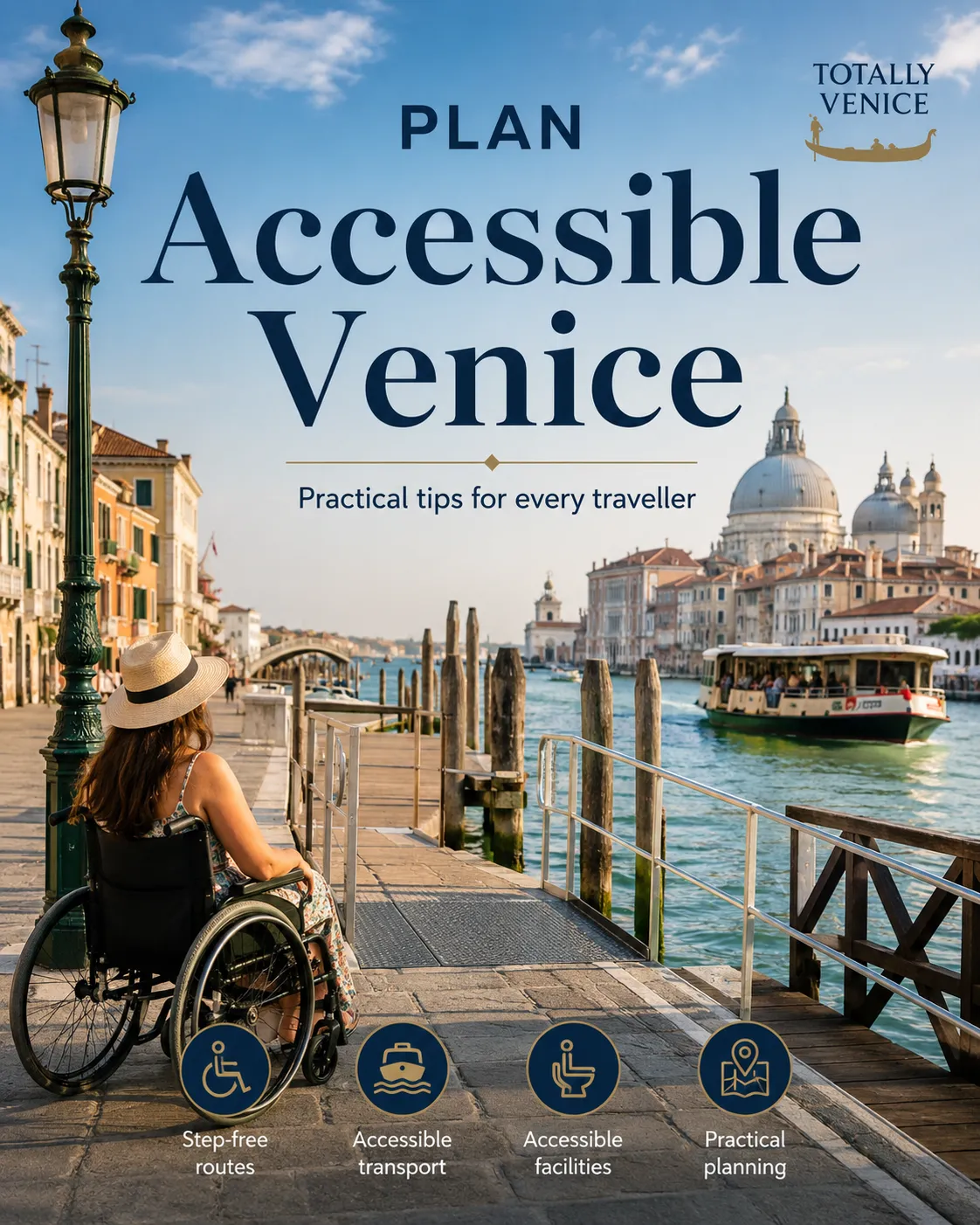
Venice is one of Europe's more physically demanding cities to navigate with limited mobility — a historic centre built entirely around several hundred bridges, most with steps, and no possibility of step-free streets in the way a modern city can offer. That said, real planning and a few Venice-specific resources make a genuine difference.
The core challenge
Almost every route between two points in Venice crosses at least one bridge, and the majority still have steps rather than ramps — a defining fact of the city's geography that no amount of planning fully removes, but that good planning can significantly reduce.
What helps
- The official accessible-route map. The City of Venice publishes a map of step-free (or ramp-assisted) routes connecting key areas, genuinely worth downloading before you go rather than relying on a general map.
- Vaporetto over walking for longer distances. Most vaporetto stops and boats are wheelchair accessible, with staff generally able to assist boarding — a far more reliable option than attempting a long cross-city walk.
- Portable ramps at some bridges. A number of the most-used bridges have removable ramps that can be requested or are installed at set times — check current locations with your accommodation, since these do change.
- Choosing your base carefully. A hotel with step-free (or minimal-step) access on a well-connected vaporetto line matters more in Venice than almost any other single planning decision.
Booking ahead
Major sights — St Mark's Basilica, the Doge's Palace, the Accademia — generally offer accessible entrances and lift access, but it's worth confirming directly and, where possible, booking a timed slot in advance so staff can be ready to assist rather than managing it on the fly during a busy period.
A realistic pace
Given the extra effort each crossing can take, building in more transition time between sights than you would in a flatter city — and accepting a shorter daily sightseeing list — tends to make for a far less exhausting trip.