
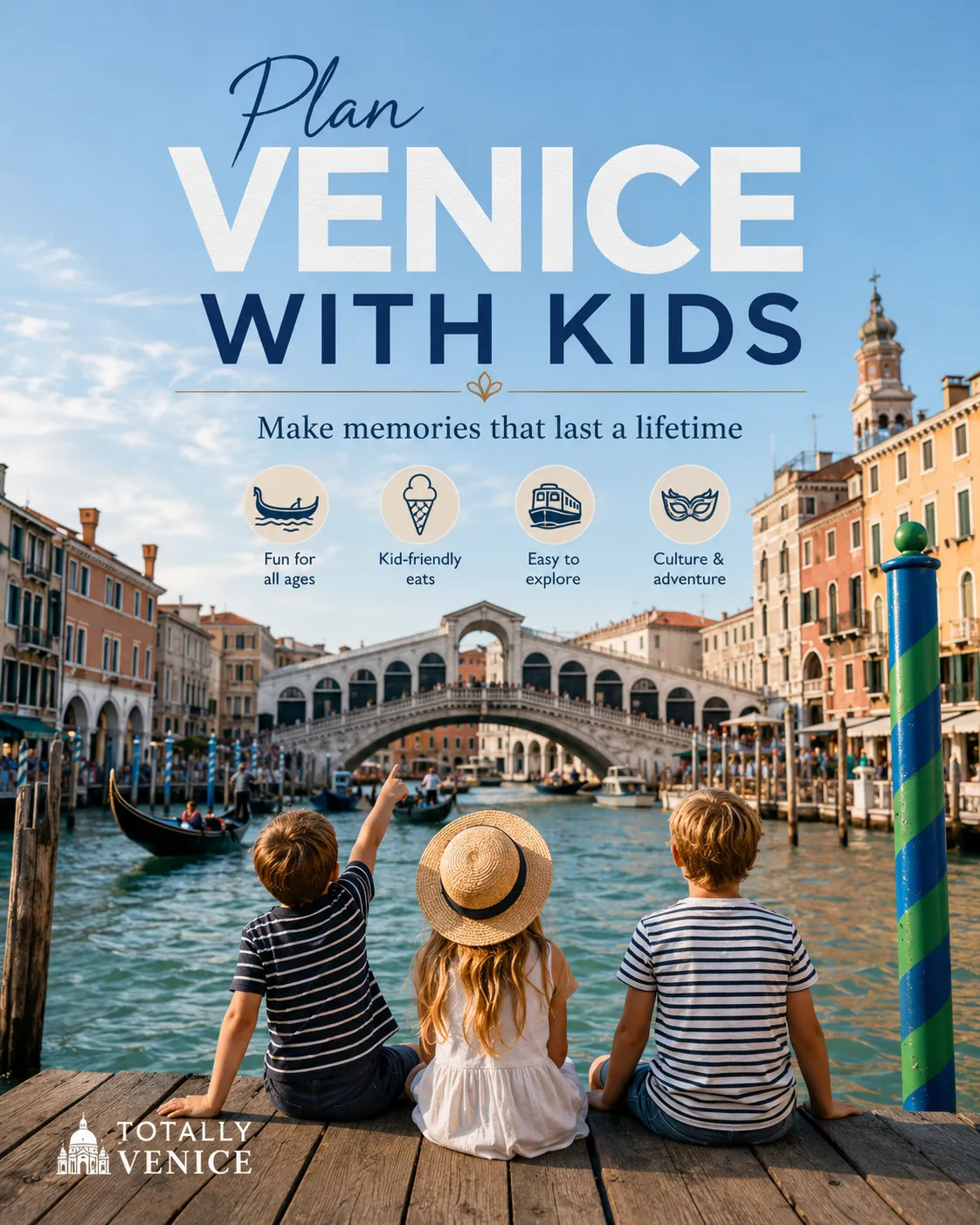
Venice can work brilliantly with children because there are no cars in the historic centre and almost every journey feels unusual. The catch is that the city is built around bridges, boats, uneven paving and attractions that can demand adult levels of patience. A good family trip therefore depends more on pacing than on squeezing in more sights.
The family strategy in one sentence
Plan one important sight, one boat journey and one unstructured block each half-day. That usually works better than trying to turn an adult two-day checklist into a child-sized version.
Why kids often love Venice
Boats are part of normal life, streets end at canals, deliveries arrive by water and there is always something moving on the lagoon. Even a routine vaporetto ride can feel like an attraction.
The historic centre is also free of normal road traffic. That removes one city-travel stress, but it does not mean young children can run anywhere: canal edges are often unguarded, quays can be slippery and busy bridges still require attention.
Strollers: possible, but bridges change the maths
A lightweight stroller is much easier than a heavy travel system. Many bridges have steps and step-free detours are not always short or convenient. Expect to lift the stroller repeatedly.
If you are choosing accommodation, count bridges, not just metres. A hotel 500 metres from the station with three steep bridges can be more tiring than a slightly farther option on a simpler route.
For a baby or toddler, a carrier can be useful for short stretches, but do not rely on it as the only solution if your child will not tolerate long periods in one.
Vaporetto with children
ACTV water buses are the backbone of public transport. A standard visitor ticket is currently €9.50 for 75 minutes on the urban network including waterborne services, excluding specific routes and airport travel. ACTV also sells 24-hour, 48-hour, 72-hour and 7-day options.
Validate the ticket as required and keep the same payment medium if using contactless best-fare systems. For a family doing several boat trips, compare passes before buying repeated singles.
At busy stops, keep children close and let disembarking passengers clear before boarding. Large strollers are much easier outside the busiest commuter and sightseeing periods.
Make the vaporetto part of the fun
Line 1 down the Grand Canal is slow enough to function as a sightseeing ride. Use it when everyone needs a seated break rather than treating every transfer as dead time.
A ride to the Lido, Murano or Burano can also turn a transport day into a simple adventure without needing another formal attraction.
Good family sights
Doge's Palace works best with older children who enjoy secret passages, armour, prisons or dramatic history. Do not expect younger children to care about every ceremonial room.
St Mark's Basilica can be visually impressive even for children, but timed entry, dress rules and crowd management mean it should be one focused stop rather than part of a five-church marathon.
Murano is useful when you can see glassmaking in a responsible, organised setting. Avoid turning the day into shop after shop.
The Lido is the easiest pressure-release option in warm weather. Beach time gives children a genuine break from churches, queues and stone streets.
Gondola or traghetto?
A gondola ride is expensive but memorable and simple to understand as a family experience. If the full ride does not fit the budget, a traghetto crossing gives a very short traditional gondola-style crossing of the Grand Canal for a fraction of the experience and time.
Young children should remain seated and follow the boat operator's instructions. Do not turn boarding or standing for photos into a safety argument.
Food is easier than many parents expect
Venice has plenty of child-friendly food without needing a separate 'kids menu'. Pizza, pasta, polenta, simple seafood, tramezzini and gelato are easy to find.
Cicchetti bars can work for families at quieter times because you can order small portions and leave without committing to a long meal. At peak aperitivo time, some tiny bacari become crowded and standing-room heavy; choose a calmer place if you have a stroller or tired child.
Carry a small emergency snack for queues, but make proper meals part of the schedule. Hungry children make Venice's navigation feel twice as complicated.
Toilets, water and heat
Do not wait until a child urgently needs a toilet. Public facilities and paid toilets exist, but they are not on every corner. Use museum, restaurant and major transport opportunities sensibly.
In hot months, refill water, seek shade and slow down in the middle of the day. Venice's combination of paving, bridges and standing can make heat more tiring than the temperature number suggests.
Acqua alta and wet-weather days
MOSE now reduces the impact of the highest tides, but lesser high-water conditions can still affect low areas. If a tide warning is current, check official municipal information and adjust routes rather than treating the day as ruined.
For rain, choose one major indoor attraction, a long lunch and a shorter neighbourhood walk. Trying to 'make up' lost outdoor time by overloading the next day usually backfires with children.
Where to stay with kids
The best family base is rarely the hotel with the fanciest lobby. Prioritise:
- a short, simple route from a vaporetto stop;
- as few bridges as practical;
- enough room for everyone to sleep properly;
- breakfast or easy food nearby;
- a location that lets you return for a break.
Cannaregio can work well for families wanting calmer evenings while still being walkable. Santa Croce can simplify arrival from Piazzale Roma. San Marco is convenient for headline sights but can be expensive and crowded.
See our family-friendly hotels guide and best areas to stay guide before booking.
A realistic two-day family rhythm
Day one: early St Mark's area, one major sight, lunch, hotel/rest time, then a vaporetto ride and relaxed neighbourhood dinner.
Day two: Murano or the Lido depending on weather and interests, return in the afternoon, gelato and an unstructured wander, then one final evening experience.
That may look light on paper. In Venice, with bridges, boats and spontaneous stops, it is usually enough.
Teenagers need a different trip
With teenagers, give them some ownership: choose the neighbourhood for dinner, photograph hidden details, navigate one route, or pick between an island trip and a museum. Venice becomes more engaging when they are not simply being marched between adult-selected monuments.
The Film Festival, Biennale exhibitions and contemporary art spaces can also be much more appealing to older children than another Renaissance church.
Safety around water
Venice is a working lagoon city, not a theme park. Canal edges are not consistently fenced, boat traffic is real and steps can be slick. Keep younger children beside you near quays and boarding points, especially at night or in rain.
Bottom line
Venice with kids works best when you do less and make the movement part of the experience. Stay somewhere logistically easy, use boats as both transport and entertainment, avoid stacking museums, and leave space for gelato, playground-style wandering and simple downtime. The goal is not to prove children can survive an adult Venice itinerary; it is to give the whole family a Venice trip they actually enjoy.