
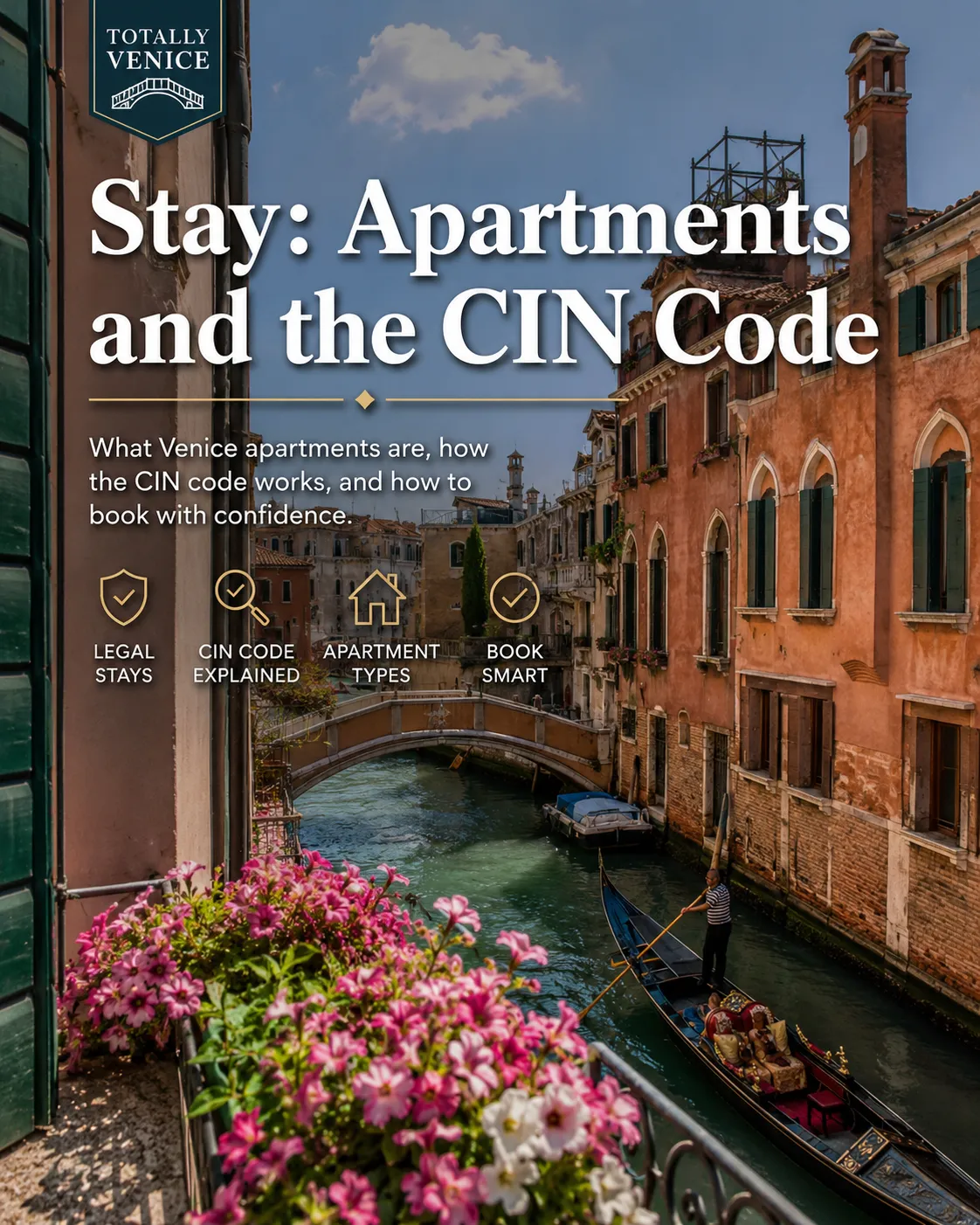
Short-term rental apartments make up a large share of Venice's visitor accommodation, and Italy's national registration system gives you a straightforward way to check a listing is legitimate before you book.
The CIN code
Since Italy introduced its Codice Identificativo Nazionale (CIN), every short-term rental property must display this code in its listing — on booking platforms and in any advertising. It's a national registration number, not a quality rating, but its presence confirms the property is registered with the relevant authorities rather than operating informally. If a Venice listing doesn't show a CIN code anywhere, treat that as a reason to ask questions before booking.
What the code doesn't tell you
A valid CIN confirms registration, not comfort — it won't tell you about stairs, noise, or how far the nearest vaporetto stop actually is. Those checks are still on you.
Questions worth asking before you book
- How many floors, and is there a lift? Venice's building stock is old and narrow; many apartments are up several flights of stairs with no elevator.
- Which vaporetto stop, and how many minutes on foot? Venice's street numbering doesn't map to intuitive distances the way most cities' addresses do — ask directly rather than guessing from a map.
- Ground floor and acqua alta: if the apartment is at street level in a lower-lying area, ask what the property's flood plan is for the handful of high-water days each winter.
- Check-in logistics: Venice's tangle of alleys makes self-check-in with a lockbox genuinely harder to find than in most cities — confirm exactly how you'll get the keys and whether someone can meet you if you get lost.
Apartment vs hotel, briefly
An apartment usually wins on space, a kitchen, and value for groups or longer stays; a hotel wins on staffed help when something goes wrong in an unfamiliar city. See our full hotels vs apartments guide for the longer version of this trade-off.